Have you ever thought about how many common expressions refer to both the human body and buildings? A stately home; an imposing person; a sturdy lad; the house has good bones. How’re you holding up? Still standing! Conversely: a deteriorating medical condition; emotional fragility; she does not feel a home in her body; a nervous breakdown.
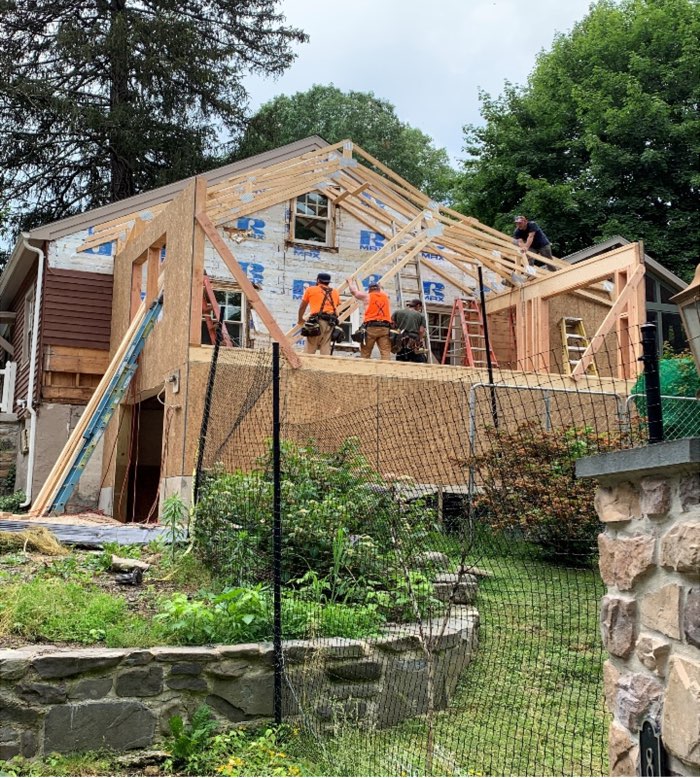
The pancaking of a 12-story condo in Surfside, Florida, came shortly after the foundation for an addition to my 1930s cottage was completed. It took 10 weeks to prepare the ground to support this new two story, 660 square foot structure. Why did it take so long?
Watching the first two and a half months of construction awakened memories of my daughters’ first two and a half months of life when parenting was 24/7. Similarly, workers were here every day, measuring, digging, remeasuring, digging some more. The cottage is sited on top of underground springs that trickle down to the Patapsco River; underground water had to be redirected. For several weeks, men did nothing but move piles of dirt around, checking throughout the day to see that the slope remained correct and drains were removing all the underground water away from the footings. At the end of the day, the foreman would call out, “time to put it to bed,” or “button her up.” The foundation caretakers were a cheerful lot, laying cinder block, inserting rebar into concrete, and smoothing the slab as they sang along to a radio playing upbeat music.
We know from studying human development how important the early months of touching and talking to an infant are in establishing a secure base to weather the storms of life. The last day the workers swaddled the slab with a cushiony substance to protect it during the framing. As his hands fluttered skyward, the foreman said, “Tomorrow, it will start to grow up. Big and strong.”
Tarpley Long, LCSW-C
Member, Washington Baltimore Center for Psychoanalysis