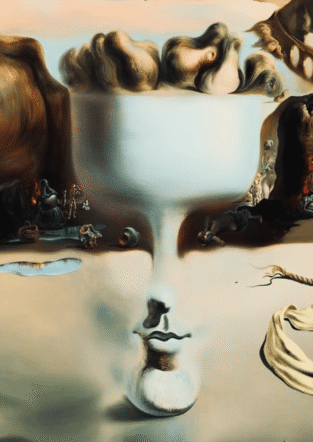
When I tell people I’m a psychiatrist, sometimes they ask, “So, are you a Freudian, a Jungian, or a Kleinian?” As an insight-oriented therapist and psychoanalyst, I think we have entered a new era in which such labels no longer fit. Like many of my colleagues, I value several conceptual models, which raises a question: how do I make sense of complex clinical situations without the help of a unified theory?
What works for me is to hold the theories I know in reserve, in the background. Since they are based on empirical evidence, I consider them to be “science,” but I also approach clinical work as an “art,” often relying on intuition, or inspiration. As I listen with open-minded attention, I wait for a clarifying synthesis to emerge, perhaps linked to a theory I hold “on call,” perhaps not. The most useful synthesis often comes unbidden and abruptly, seemingly out of the blue.
The idea that art and analysis both rely on inspiration is a central thesis of Ernst Kris, who was first an art historian and later a renowned psychoanalyst. In his collected essays of the 1930s, Psychoanalytic Explorations in Art, he writes, “wherever art reaches a certain level, inspiration is at work.” Twenty-five years later, in his paper on “Insight in Psychoanalysis,” he states that “the good analytic hour” depends on inspiration, which he describes as follows: “…(it) all begins to make sense…one of the associations has suddenly lifted the veil…associations suddenly ‘converge’…the material comes as if prepared…outside awareness…”
In line with Kris, I find that analytic therapy reaches its potential when both participants open themselves to this preconscious creative process.