
PsychBytes

A publication of the Washington Baltimore Center for Psychoanalysis

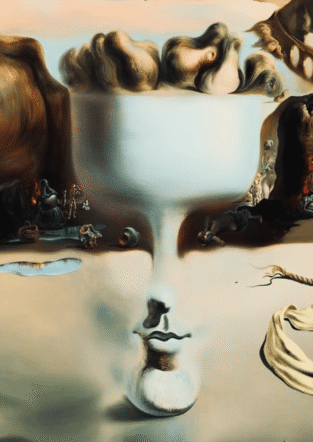
Salvador Dali, Apparition of Face and Fruit Dish on a Beach, 1938 Wadsworth Atheneum Museum of Art, Hartford, CT

Share This Post

The Eloquence of Silent Dreams

J. David Miller, MD
Member, Washington Baltimore Center for Psychoanalysis
September 2026 | Volume 10 | Issue 1

Although psychoanalysis is based on “putting it into words,” most dreams, Freud’s “royal road to the unconscious,” lack spoken words. Researchers believe such dreams are silent because they tap pre-verbal experience, enabling them to achieve a profound ambiguity. The specificity of words can narrow that potential.

This limitation comes through in Michael Glenn’s book of “Dream Poems.” The poems narrate his dreams, but do so with added spoken words. In one dream, a woman stares through a window at him and his partner in bed; the woman later adamantly denies it. In his poem, the dreamer attacks her denial: “I saw you looking/ I saw you looking/ I saw you looking/ That look…” In the dream itself, these words would dramatize his rage, but distract from other meanings. For example, the staring woman may reflect Glenn’s primal pleasure in being “seen.”

Since silent dreams lack words that pin down meaning, they retain their ambiguity, which adds to their eloquence. Patients can access multiple, often profound meanings in what these dreams “say.” To illustrate: a patient reported a silent dream in which a tug-of-war with his ex-wife led to her “accidentally” plummeting off a cliff. At first he saw this dream as expressing his relief in having her out of his life: “I’m done trying to communicate with her.” But then he added, emphatically, “I did not see her face.” His disclaimer led me to say, “You dread seeing what the fall did to her.” He agreed, admitting (with guilt and relief at sharing it) that the dream also expresses his murderous rage toward his ex-wife.

Silence can add to the eloquence of a dream, maintaining the ambiguity and depth of its visual content that patients may decipher, verbalizing content they had been unable to access, let alone put into words.

Explore more in PsychBytes

The Eloquence of Silent Dreams

Although psychoanalysis is based on “putting it into words,” most dreams, Freud’s “royal road to the unconscious,” lack spoken words. Researchers believe such dreams are silent because they tap pre-verbal experience, enabling them to achieve a profound ambiguity. The specificity of words can narrow that potential.
I have never had that kind of house.

I have moved every two to four years for as long as I can remember. My life can be mapped through new cupboards and unfamiliar ceilings. I learned early how to fold myself into spaces never meant to hold me for long. Even now, some part of me is already preparing an exit.

On Leaving and Holding

One aspect of Joachim Trier’s 2026, Academy Award-nominated film, Sentimental Value, lingers: the idea that a house can hold memory, and in doing so, remind people of who they are and who they have been. The family home in the film becomes a kind of unconscious structure, a repository for grief, history, and the versions of themselves they could not keep.

I have never had that kind of house.

I have moved every two to four years for as long as I can remember. My life can be mapped through new cupboards and unfamiliar ceilings. I learned early how to fold myself into spaces never meant to hold me for long. Even now, some part of me is already preparing an exit.

Content Edit Request

Content Edit Request

Please submit one request at a time.