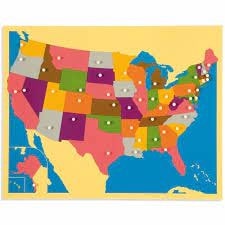
A favorite amusement during my elementary-school years was a puzzle-map of the United States. The puzzle pieces comprised all the states. The top of the puzzle went beyond the USA halfway up Canada, and the bottom ended halfway through Mexico.
When I was 9, I learned we were moving to El Salvador. I asked my dad where that was, and he said “below Mexico.” I remember standing still, in considerable confusion, pondering this radical information: there was land below the end of my puzzle. I recall how the news gradually spread through my imagination and challenged my concept of the world. The sense of expansion and of new possibility felt exhilarating, but also bewildering.
Borders on maps are really just ideas that humans impose on the land, and on populations. But they feel real, concrete, not just mental. And they have real consequences. We police them, we spend millions of dollars on walls to prevent unauthorized access across them and deport people who manage to cross anyway. We get into wars over them.
Psychological boundaries can feel just as real and are just as artificial. They provide a sense of stability and security, but often they can be unnecessarily limiting. They can make life small and difficult.
Our patients often come to psychotherapy or psychoanalysis because they are struggling with how they view the world and themselves and their relationships. Ideally, the therapeutic relationship provides a safe context for exploring their established beliefs about their lives. They often have vague notions that there is more to their world than they can recognize on their own. They discover, like sea-faring voyagers of old, that their internal maps can be inaccurate, distorting their personal and relational landscapes. But through exploration, over time, their psychological maps can be reconfigured, enlarged, allowing for a whole new world of discovery and experience.
The borders open. The walls come down.